Bandwagoning
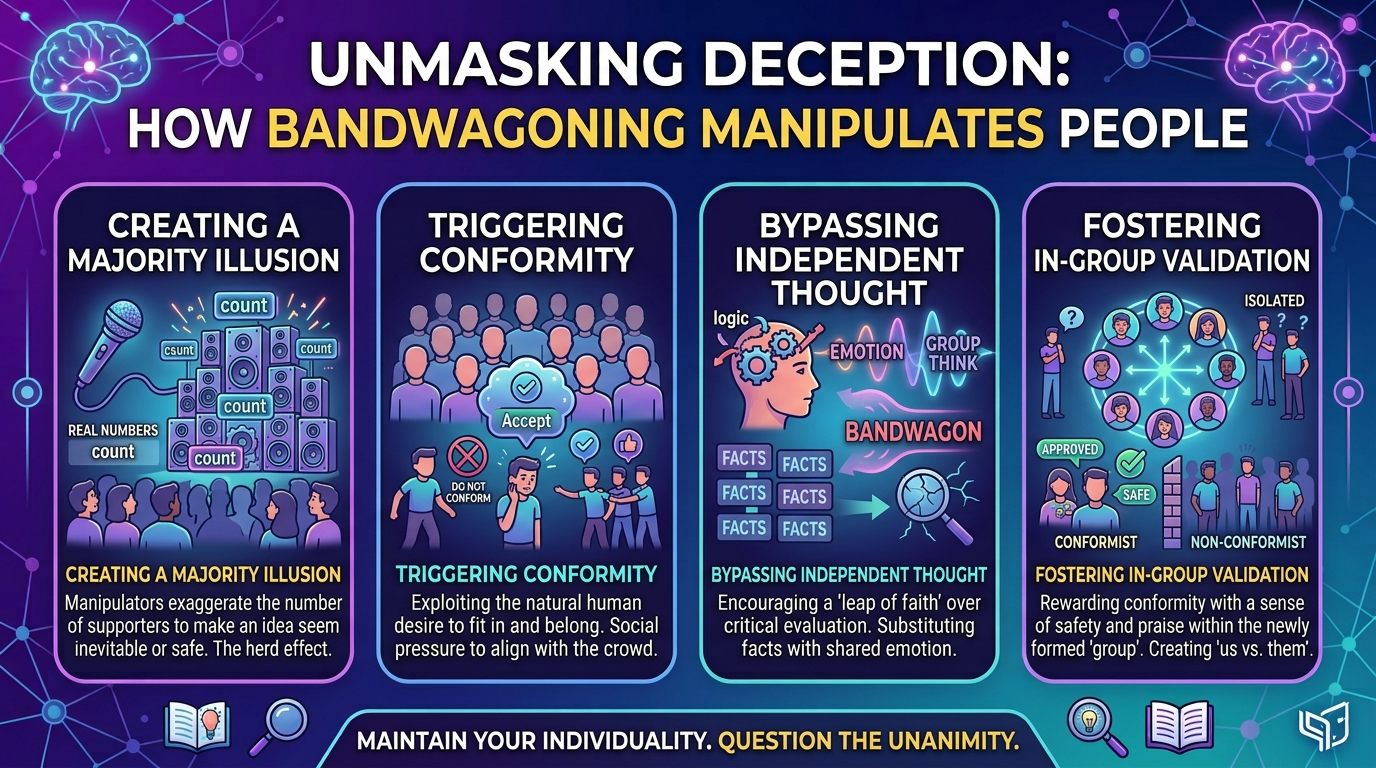
The psychological effects of the bandwagon effect are driven by social pressures and cognitive shortcuts, leading people to adopt popular beliefs, attitudes, and behaviors to fit in or be on the "winning" side". This can override individual preferences and critical thinking, with outcomes that can be either harmless or harmful.
Psychological effects of the bandwagon effect
-
Desire for social belonging: People are motivated to join the majority to fit in and feel included with the group. This desire to belong is a key driver of conforming to popular opinions or behaviors.
-
Mental shortcuts: It is easier and requires less mental energy to follow the crowd rather than perform a deep evaluation of every choice. The bandwagon effect uses this cognitive ease, making people believe that if a lot of people are doing something, it must be the correct or best option.
-
Belief in social proof: People tend to assume that a large group of people is more likely to be right than an individual. The behavior or belief of the majority is seen as social proof that it is the correct or desirable choice.
-
Conformity and avoiding being the "odd one out": Individuals may conform to group behaviors to avoid social disapproval or to feel accepted. Standing out against a widely accepted norm can be perceived as disadvantageous or even dangerous, so people may unconsciously choose to go along with the group.<
-
Influence on decision-making: The effect can lead to the adoption of opinions, beliefs, and behaviors without conscious thought or evaluation of facts. This can result in a herd mentality or groupthink.
-
A desire to be on the "winning" side: In situations like elections, there can be a desire to support the candidate or party that is perceived as the winner. This motive can lead people to change their vote to conform to the leading side.
Trump's Use of Bandwagoning
Crowd Size as Proof of Truth
- Rhetoric: Trump regularly uses the scale of his rally crowds to validate his policy proposals or political claims.
- The Fallacy: A statement like, "Look at this crowd—millions of people across America are with us because they know we're right!" uses sheer numbers to establish correctness.
- The Reality: In logic, popularity does not equal factual truth. Large group agreement does not mean a statement is factually accurate.
- Rhetoric: During debates and press conferences, Trump frequently answers critiques of his policy or behavior by citing his poll numbers.
- The Fallacy: For instance, when challenged by opponents during primary debates, he routinely deflected by pointing out that he was leading by large margins while his opponents were at much lower percentages.
- The Reality: High poll numbers measure political popularity, but they are logically irrelevant to whether a specific policy proposal is practical or effective.
- Rhetoric: Trump heavily utilizes uniform physical trappings at his events, such as forests of flags and matching red MAGA hats.
- The Fallacy: This systematic branding builds a highly visible, physical bandwagon effect. It creates an "everyone is doing it" visual environment.
- The Reality: The intense visual saturation leverages the human desire for social belonging. It makes opting out feel like becoming an outsider, separate from a patriotic majority.
- Rhetoric: Trump often describes his political coalition as the “greatest movement in the history of our country.”
- The Fallacy: This sweeping generalization urges undecided voters to jump on board before it is too late.
- The Reality: This historic inevitability claim uses emotional momentum and social pressure to bypass critical analysis of specific actions or policies.
- "We will win so much, you may even get tired of winning": A sweeping, hyper-optimistic promise of absolute success that focuses entirely on the positive emotional concept of victory rather than realistic or measurable outcomes.
- "The common good", "long-term peace", and "regional stability": Vague moral frameworks used in foreign policy rhetoric—such as framing alternative diplomatic initiatives—to sound indisputable while masking debated political agendas.
- "Election integrity" and "transparency": High-concept, universally praised democratic values utilized as rhetorical shorthand during political messaging to validate specific actions or narratives without providing full context.