Repetition
Cognitive and Emotional Effects
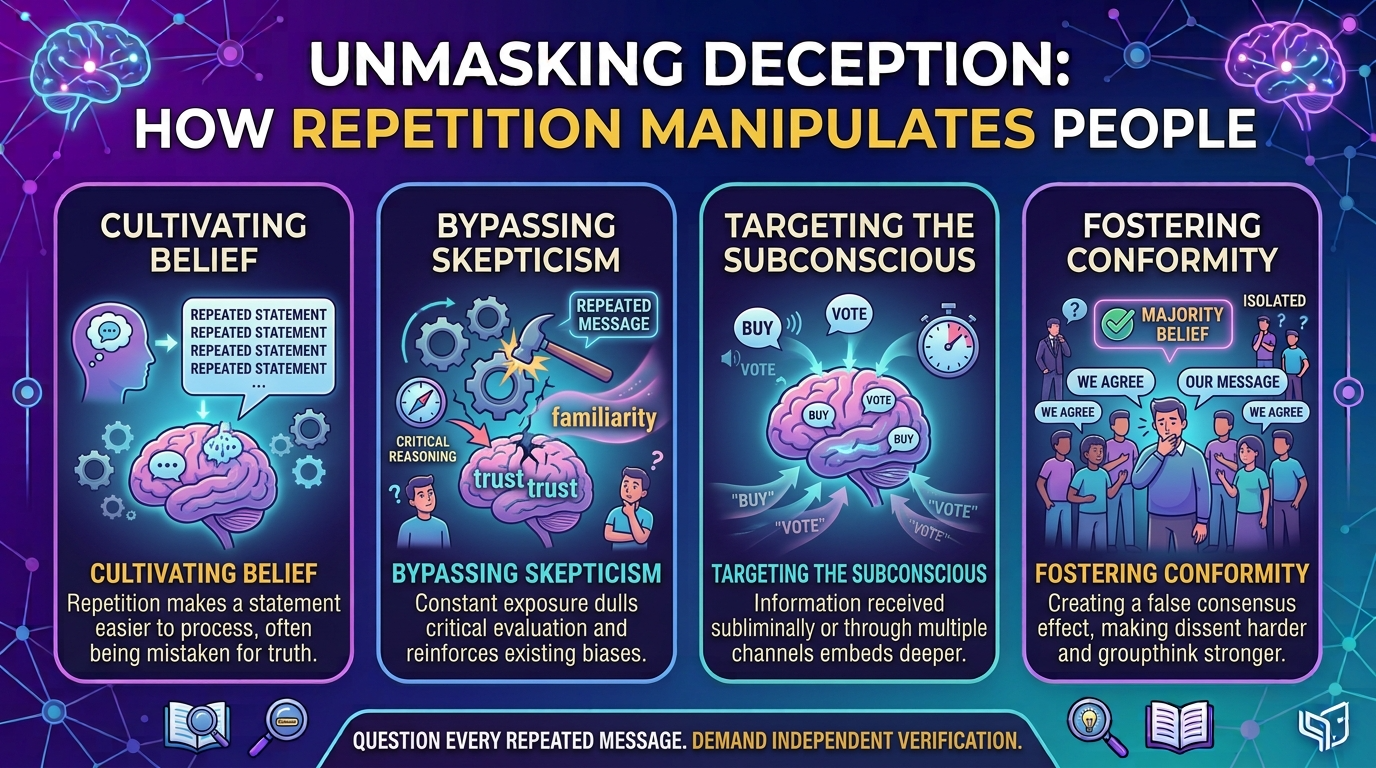
- Illusory Truth Effect: Repeated exposure to political statements, even false or misleading ones, makes them seem more truthful. The brain uses familiarity (processing fluency) as a shortcut for truth, which makes people more susceptible to propaganda and "fake news," even if they initially knew the information was false.
- Chronic Stress and Anxiety: Constant exposure to an emotionally charged and polarized political environment, often via social media and news outlets, contributes to a pervasive sense of sociopolitical stress. This chronic stress is a major source of anxiety for a significant portion of the population and can lead to:
- Worry and fear.
- Hopelessness and depression.
- Loss of sleep.
- An inability to stop thinking about politics.
- Psychological Exhaustion (Fatigue): The relentless, repetitive nature of the 24/7 news cycle and political messaging causes many people to feel worn out and exhausted by politics, leading some to tune out entirely to protect their mental health.
- Negative Attitudes and "Boomerang Effects": While repetition generally increases belief, research indicates that an excessive amount of repetition of negative political messages can sometimes have a "boomerang effect," decreasing the message's credibility and potentially fostering negative attitudes toward the politician or issue being promoted.
Social and Democratic Effects
- Erosion of Trust: When politicians repeatedly cast doubt on the legitimacy of elections or other institutions, it normalizes election denialism and erodes public trust in democracy and governmental entities.
- Increased Polarization: Repetition of partisan rhetoric can deepen existing ideological divides, leading people to demonize those with opposing views and making productive dialogue difficult.
- Withdrawal and Isolation: Political stress can cause individuals to withdraw from social and political life, leading to isolation and suspicion.
- Behavioral Impact: Belief in repeated misinformation can influence real-world actions, such as contributing to vaccine hesitancy or discouraging people from voting if they believe the system is corrupt.
Repetition used for Trump Exploitation
Donald Trump has frequently utilized repetition—a core mainstay of propaganda—to influence public perception. In political communication and psychology, this tactic relies on the illusory truth effect, where people tend to believe false or misleading statements simply because they have been exposed to them repeatedly.
Historians, linguists, and media analysts have documented several prominent examples of Trump using repetition to frame debates, discredit opponents, and establish alternative narratives:
The "Big Lie" Regarding the 2020 Election
Perhaps the most notable example is Trump's sustained insistence that the 2020 presidential election was "stolen" or "rigged". He began planting seeds of doubt about election integrity long before voting took place and continued to repeat the claim hundreds of times across rallies, press releases, and social media. This systematic repetition normalized the narrative among his base, despite more than 60 failed court challenges and verified audits confirming the election results.
Branding the Press as "Fake News" and the "Enemy of the People"
To neutralize critical reporting, Trump heavily relied on short, weaponized catchphrases. By repeating the terms "Fake News" and "Enemy of the People" thousands of times throughout his political career, he trained his supporters to instinctively dismiss factual media reporting that cast him in a negative light. This linguistic framing fundamentally altered how information was consumed by his audience.
Dehumanizing Language and "Invasion" Rhetoric Around Immigration
Trump frequently repeats specific, high-urgency buzzwords to describe unauthorized immigration at the southern U.S. border.
- "Invasion": Analysis of his speeches reveals he used the word "invasion" dozens of times to characterize migrant arrivals, deliberately conjuring the imagery of an invading foreign enemy force.
- "Poisoning our country" and "Migrant Criminals": Computer-aided text analysis by The Marshall Project processed over 350,000 of Trump’s public statements and identified 13 major immigration claims—many repeated 500 times or more—that rely on phrases like "illegal monsters" or "killers" to appeal to fear and emotion over statistics.
Catchphrase Labeling of Investigations ("Witch Hunt")
Whenever facing legal scrutiny, oversight, or congressional investigations, Trump systematically deploys the term "Witch Hunt" or "Hoax". Whether during the Mueller investigation, his impeachments, or his criminal indictments, applying the same repeated label reframes accountability measures as partisan, unfair persecutions.
Short, Pejorative Nicknames for Opponents<
Trump employs a branding technique common in marketing by assigning sticky, derogatory nicknames to political rivals and repeating them ad nauseam until they become synonymous with the person's identity. Examples include "Crooked Hillary," "Lyin' Ted," "Sleepy Joe," and "Little Marco." Repetition ensures that voters associate the designated negative trait with the opponent automatically, bypassing a more complex policy debate.
Why this Technique Works
Propaganda experts, such as New York University history professor Ruth Ben-Ghiat, note that Trump's use of repetition is highly intentional. In a classic breakdown of propaganda principles shared by HuffPost Politics, repetition works hand-in-hand with oversimplification. By reducing highly complex societal issues (like immigration, macroeconomics, or foreign policy) into repetitive slogans like "Build the Wall" or "Make America Great Again," the messaging bypasses logical analysis and cements itself as an emotional truth for the listener.