Transfer
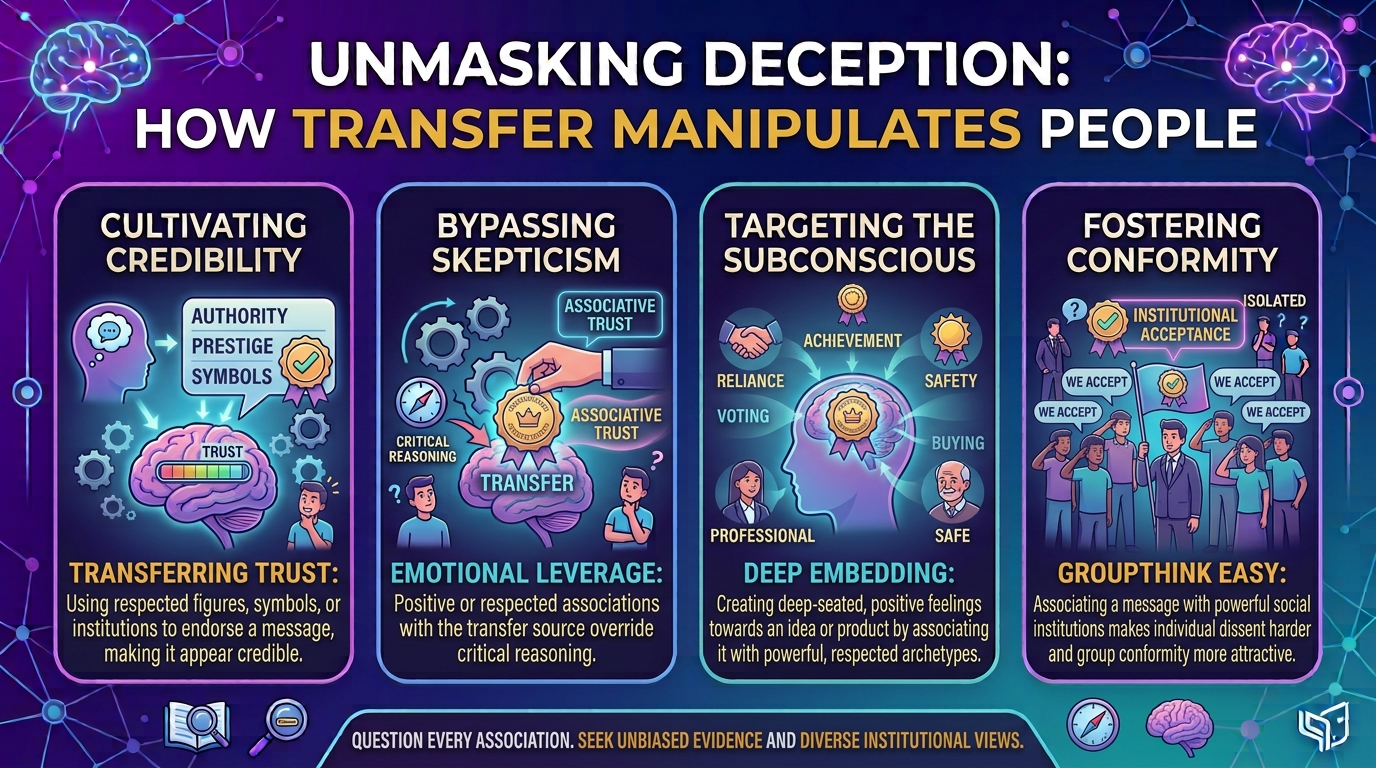
This propaganda technique is where negative emotions or beliefs associated with one thing are transferred to another to discredit it, often by using guilt by association. This propaganda works by linking a target to something the audience already views negatively, bypassing rational evaluation and instead exploiting pre-existing biases and distrust. This effect can lead to the unfair discrediting of an individual, idea, or group.
Mechanisms and Psychology
- Emotional Appeal: The technique works by evoking an emotional response and bypassing critical thinking. Emotionally charged content is more likely to capture attention and resist correction, while simultaneously reducing activity in the prefrontal cortex which controls critical analysis.
- Guilt by Association: A specific type of negative transfer is "guilt by association". This exploits cognitive biases, such as the reverse halo effect, where a single negative characteristic unfairly influences the overall judgment of a person or idea based on a perceived, often tenuous, connection.
- Cognitive Biases: The effectiveness of this technique relies heavily on the audience's existing cognitive biases, such as confirmation bias (favoring information that confirms existing beliefs) and emotional reasoning.
- Lingering Stigma: Even if the association is proven false or irrelevant, the initial negative impression can create a lingering stigma due to the continued influence effect.
Examples
- Political Discrediting: A politician might be linked to a controversial figure to imply shared negative values, even if the connection was limited or incidental.
- Dehumanization: Historical examples include World War II propaganda that used negative associations to dehumanize the enemy and instill hatred, leading to significant real-world consequences.
- Name-Calling: Attaching negative labels (e.g., "racist," "traitor") to an opponent is a form of negative transfer that aims to destroy their image without engaging in a factual debate.
This effect can lead audiences to form quick judgments based on perceived connections rather than a rational assessment of the individual's or idea's own merits, making otherwise irrelevant connections seem significant.
Trump and the "Transfer" propaganda technique
Transfer is a classic propaganda technique defined by the Institute for Propaganda Analysis (IPA) as taking the authority, prestige, or emotional force of a highly respected symbol (or a highly hated one) and visually or textually aligning it with a person or cause to transfer those exact feelings.
Here are the primary examples of Donald Trump utilizing this technique, categorized by how the associations are transferred:
Visual Backdrops and Historical Figures
- The Lincoln Memorial Town Hall: In May 2020, Trump participated in a televised virtual town hall staged directly at the foot of the iconic Daniel Chester French statue of Abraham Lincoln. Rhetorical analysts noted this as a stark example of visual transfer propaganda. By physically juxtaposing himself with a president widely revered for moral courage and preserving the Union, the staging attempted to visually transfer Lincoln’s historical authority and prestige onto Trump’s contemporary political messaging.
Institutional Symbols and "Declassification Theater"
- The Trappings of the Presidency: Media literacy experts point out that Trump frequently uses the physical symbols of national authority—such as the presidential podium, intelligence agency seals, and stacked, official-looking document folders—to validate unverified claims. For instance, during announcements regarding "declassification" or "election integrity," these highly respected symbols are used to transfer an aura of official, absolute truth to claims that may actually lack underlying evidence.
Associating Allies with Honored Groups
- Transferring Military Prestige to Endorsements: In political endorsements—such as his public backing of Representative Matt Gaetz—Trump routinely weaves in imagery of heroic military veterans and patriotic symbols. By explicitly linking a political candidate to the deeply respected status of the American military, the positive emotions the public holds for veterans are transferred directly to the candidate.
Transferring Negative Associations to Opponents
- Mobs, Witch Hunts, and Dictators: The transfer technique works in reverse to project negative emotions onto targets. Trump consistently uses highly charged, historically loaded concepts to describe political opponents and investigations:
- "Witch Hunts" and "Mobs": By labeling official congressional investigations or legal proceedings as "Democrat Witch Hunts" or the actions of a "dangerous mob," he transfers the historical lawlessness and unfairness associated with those terms onto the modern American justice system.
- Extremist Language:: Academics and civil rights organizations have noted instances where Trump’s rhetoric transfers the traits of widely condemned historical out-groups to modern political adversaries, such as using the term "vermin" to describe political enemies, which critics note borrows from the dehumanizing propaganda language of mid-20th century European autocrats.