Plain Folks
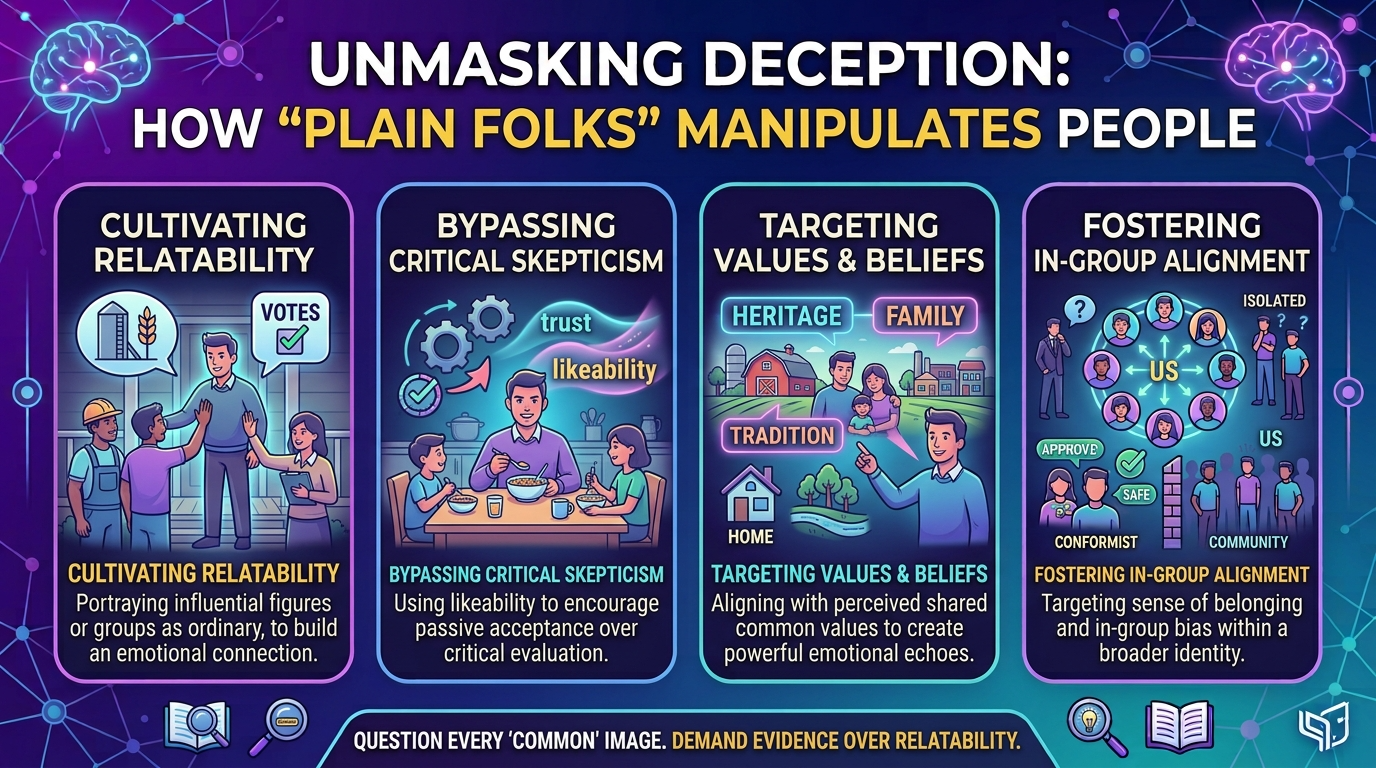
Effects on the Target Audience
- Erosion of Trust and Credibility: The technique aims to build a false sense of trust and comfort by presenting a speaker (e.g., a politician or advertiser) as an "average Joe". When the audience discovers this persona is a deliberate manipulation or that the "ordinary" people are paid actors, it can lead to a significant breach of trust not only in the individual/product but potentially in all media and public messaging.
- Suppression of Rational Thought: The technique attempts to short-circuit reasoning by asserting that because the speaker is "just like you," their message should be believed without critical evaluation of the facts or evidence. This can lead people to act in ways that may not align with their best interests, based on emotional resonance rather than factual accuracy.
- Vulnerability to Misinformation: By encouraging people to rely on shared identity and emotional connection rather than objective information, the "plain folks" appeal can make individuals more susceptible to misinformation and false beliefs.
- Alienation and Cynicism: Exposing the manipulative nature of this technique can risk alienating the audience, as calling out the manipulation may be interpreted as an attack on the values the speaker claims to embody. Over time, repeated exposure to such propaganda can contribute to a general sense of cynicism about public discourse and a feeling of powerlessness in discerning truth.
- Reinforcement of Stereotypes: If the "plain folks" portrayal relies on stereotypes of a certain social group, it can inadvertently reinforce harmful generalizations about that group's identity, values, or concerns.
Effects on Society and Discourse
- Degradation of Honest Communication: The widespread and often subtle use of "plain folks" makes it challenging to distinguish genuine authenticity from deliberate strategy, degrading the quality of public communication.
- Undermining the Democratic Process: In a political context, the technique can influence voting behavior through emotional manipulation rather than substantive policy evaluation, potentially undermining the integrity of informed democratic decision-making.
Ultimately, while the "plain folks" technique may achieve its short-term goal of persuasion, its negative psychological impact relates to its role in a broader ecosystem of propaganda that devalues evidence-based reasoning and genuine connection in favor of calculated manipulation
Examples of the "Plain Folk" technique used by Trump
Donald Trump frequently uses "Plain Folk" propaganda—a technique designed to position a speaker as an ordinary, everyday citizen who understands and shares the struggles of the common people—despite his background as a billionaire real estate mogul.
Political scientists and media researchers note that Trump alters his communication style, appearance, and public actions to present himself as a populist "outsider" fighting for the working class.
The Political "Outsider" Narrative<
The most prominent way Trump leverages the plain folk appeal is by framing himself as an anti-establishment outsider. He positions himself as a regular guy standing up against a corrupt, elite political class.
- The Mechanism: He argues that because he lacks traditional political experience, he is not corrupted by Washington and can truly represent the common citizen.
- The Message: By using the "Drain the Swamp" motif, he tells his base, "They’re not after me, they’re after you—I’m just in the way."
Tailored Visuals and Photo-Ops
Trump uses highly publicized visits to local businesses and fast-food chains to mirror the lifestyle and tastes of working-class Americans.
- Fast Food Preference: Trump frequently publicizes his love for brands like McDonald's and Kentucky Fried Chicken. Ordering fast food to the White House or eating it on his private plane serves to signal that his culinary tastes align with everyday citizens rather than high-society elites.
- Campaign Trail Uniform: While he typically wears suits, he anchors his attire with a standard, mass-produced "Make America Great Again" baseball cap. This casual, accessible accessory allows him to visually blend into his rally crowds.
"Unfiltered" Communication Styles
Academic analyses of Trump's social media footprints reveal that his use of language acts as a digital plain folk appeal.
- Conversational Vocabulary: Instead of relying on the polished, teleprompter-heavy jargon of career politicians, Trump uses simple vocabulary, nicknames, and short, exclamation-heavy sentences.
- Direct Access: Using platforms to air his raw thoughts, grievances, and feelings directly to the public bypasses institutional media filters. This conveys authenticity, making his followers feel like they are hearing directly from a peer rather than an unapproachable head of state.
Summary of Strategic Impact<
| Tactic | Execution | Plain Folk Objective |
| Rhetoric | Uses simple, aggressive, and direct vocabulary. | Rejects elitist, over-intellectualized political speech. |
| Staged Events |
Visits factories, local diners, and eats fast food. | Mimics the daily habits and tastes of the working class. |
| Framing | Promotes an "outsider" status fighting the establishment. | Builds an in-group alliance between himself and regular citizens. |
You can see how powerful this propaganda technique can be. Trump is far from "Plain Folk". His supporters actually believe this nonsense.