Fear Mongering
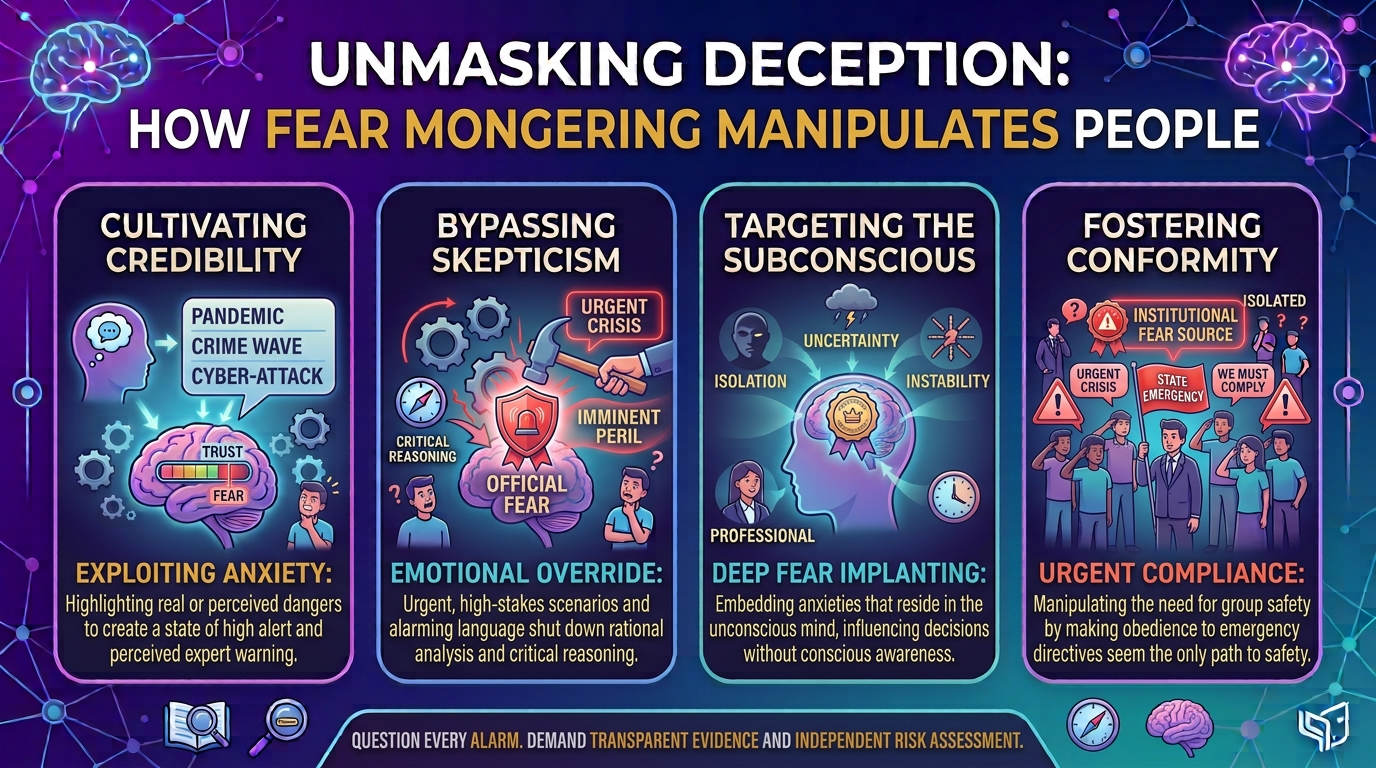
Psychological impacts of fear-based propaganda
- Distorted reality: Fearmongering can lead to "mean world syndrome," where individuals perceive the world as more dangerous than it actually is, causing them to fear unlikely threats while ignoring more probable ones.
- Erosion of critical thinking: Fear and anger are "action emotions" that can bypass logic, leading people to seek comfort and reinforce their existing beliefs rather than fact-checking. This makes them more likely to believe and share misinformation, especially when it comes from sources they trust.
- Increased susceptibility to misinformation: Emotionally charged content is more likely to grab attention and make it harder to discern truth from fiction, leading people to accept false information as fact.
- Formation of defensive reactions: When fear appeals are too strong or the individual feels a lack of control, they may resort to "defensive avoidance" to lower their anxiety, which can involve ignoring the threat or becoming apathetic.
- Political manipulation: Fear is a powerful tool in politics to drive votes, demonize opponents, or even suppress voter turnout by making people anxious to the point of abstaining from voting.
- "Diffusion of distrust": Constant exposure to fear-based, sensationalized, and contradictory information can lead to a general distrust of media and institutions, even for those trying to be well-informed.
Trump the "Fear Monger"
Donald Trump has frequently been analyzed by political scientists, historians, and media critics for his use of "fear-mongering" propaganda. This rhetorical strategy leverages the audience's anxieties regarding security, economic stability, or cultural identity to build political support, demand loyalty, or delegitimize opponents.
Critics point to several prominent examples of this tactic across his political career:
Immigration and "Invasion" Rhetoric
Trump’s political identity is heavily anchored in framing immigration as an existential crisis.
- The 2016 Campaign Launch: In his 2016 Presidential Announcement Speech, he characterized Mexican immigrants as rapists, criminals, and drug traffickers bringing infectious disease into the United States.
- Migrant Caravans (2018 Midterms): Leading up to the 2018 midterms, Trump frequently warned of an "invasion" from Central American migrant caravans, falsely claiming on social media that the groups contained "unknown Middle Easterners" and MS-13 gang members to heighten national security fears.
- Dehumanizing Language: In multiple campaigns, he has stated that undocumented immigrants are "poisoning the blood of our country" and compared them to an "infestation", language that historians note mirrors classic xenophobic propaganda.
Crime and "Law and Order" in American Cities
During his presidency and subsequent campaigns, Trump has consistently depicted American cities—particularly those led by Democrats—as crime-ridden dystopias.
- The "American Carnage" Inaugural Address: In his 2017 Inaugural Address, Trump painted a bleak picture of the nation, focusing heavily on "the crime and the gangs and the drugs" that he claimed had devastated American communities.
- The 2020 Summer Protests: Following civil unrest after the murder of George Floyd, Trump ran ads depicting ablaze cities with captions warning that "you won't be safe in Joe Biden's America". He frequently claimed that "Antifa" and "radical left anarchists" were coming to destroy suburban neighborhoods.
Public Health and External Threats
Trump has used fear-mongering to deflect responsibility during crises by redirecting public anxiety toward foreign actors or marginalized groups.
- COVID-19 and the "Chinese Virus": During the 2020 pandemic, Trump consistently ignored public health guidance and branded COVID-19 as the "Chinese Virus" or "Kung Flu". Civil rights organizations warned that this rhetoric stoked fear and xenophobia, directly contributing to a documented rise in anti-Asian hate crimes.
- Anti-Muslim Rhetoric: Early in his 2016 campaign, Trump capitalized on public fear of terrorism by calling for a "total and complete shutdown of Muslims entering the United States." Later, as president, he retweeted unverified, highly inflammatory anti-Muslim videos posted by a British far-right extremist group to stoke domestic anxiety.
Economic and Political "Bloodbaths"
Trump frequently frames elections not as policy choices, but as doomsday scenarios for the country's survival.
- Predicting Systemic Collapse: In his 2024 campaign rallies, Trump argued that if he is not re-elected, the American economy will suffer a "bloodbath", the U.S. auto industry will be completely annihilated, and the nation will descend into "bedlam" and World War III.
- The "Deep State" and Retribution: He uses fear of federal institutions to consolidate power, asserting that a corrupt "Deep State" is weaponizing government against his supporters, and framing his candidacy as the only shield against total political persecution.